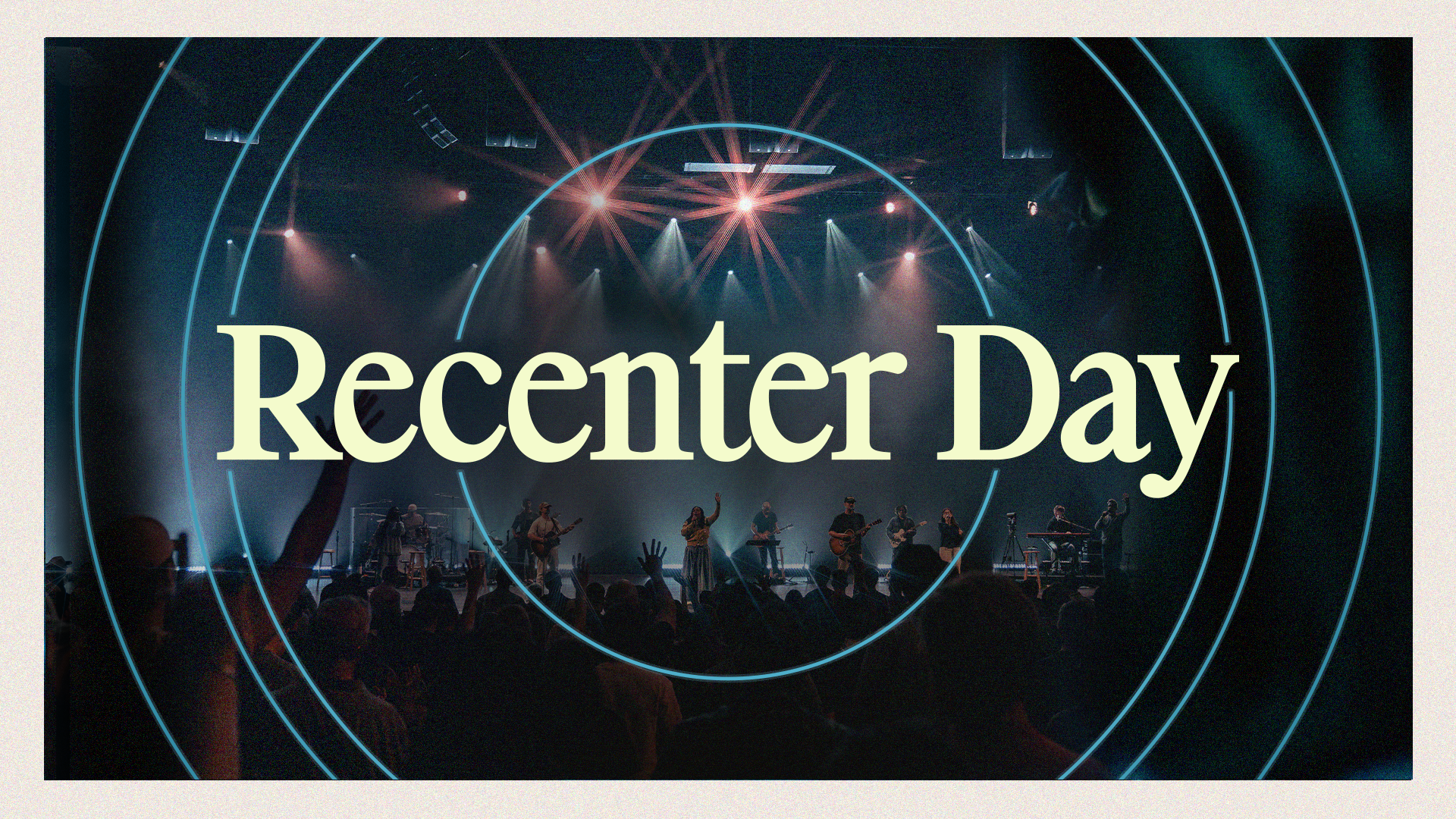
Recenter Days are dedicated to helping our beloved church family enjoy our union with Christ together. Properly understood, Watermark’s vision—abiding in Jesus, we are making disciples together—depends on our living union with Christ. It’s all too easy to hyperfixate on spiritual activity (making disciples) and spiritual fellowship (doing life together) while somehow forgetting the spiritual intimacy (abiding in Jesus) that enables, empowers, and enlivens it all. Without union with Christ, the spiritual life is no life at all.
Our prayer is that Recenter Days would serve as consistent reminders of God’s great gifts to us in giving us Jesus Christ, who is grace himself. Appropriately, Paul’s striking portrait of Christ and his glory in Colossians 1:15-20 will serve as our guiding text for Recenter Days. Before anything, thank God for his gracious gift in Jesus and ask him to recenter your heart in him today.
READ COLOSSIANS 1:15-20
Ask God to work in your heart through the reading of his Word. Then, begin by reading Colossians 1:15-20. Read it slowly, thoughtfully, and repeatedly, pausing for reflection between readings. Then, read it aloud. Notice the glorious Christ pictured here—ask God to renew your faith in this Christ, nothing less.
GOD’S TRUEST AND BEST IMAGE
“He is the image of the invisible God, the firstborn of all creation.” (Colossians 1:15)
Paul describes Jesus as the invisible God’s image. God is not a material being like you and me; physical eyes fail to see spiritual realities. But in Christ, God reveals himself in full—as Christ himself said, “Whoever has seen me has seen the Father” (John 14:9). Jesus perfectly shows us what God is like.
That God created man to be in his image should both heal and humble our hearts (Genesis 1:26-27). Healing comes as we learn of the glory God bestows on simple men like us. We are created, finite, limited beings, bound by time and space. Yet, God proclaims: “Of all creation, you look most like me!” Humility shortly follows, for our personal God-pictures are bleak. Adam, the first man and God’s human son, was made to glorify and enjoy God; instead, he betrayed his Creator and served himself. We’re just the same.
Yet, God’s divine Son is different; he is God’s better picture. We are created; he is Creator. We are finite; the Son, infinite. He transcends our limits and reigns over time and space. Like us, he images God; unlike us, he does it perfectly. Even further, he is also creation’s firstborn, which echoes God’s promise to send a king to redeem his covenant people (Psalm 89:27). Thus, God’s uncreated Son enters into creation to rule over it so that men like us could come to see the invisible God.
Pray to the God who wants to be known. Praise God for making you in his image; confess ways you’ve failed to properly picture him; thank him for the redemption and example Jesus provides.
UNITED TO THE VICTORIOUS CHRIST
“For by him all things were created, in heaven and on earth, visible and invisible, whether thrones or dominions or rulers or authorities—all things were created through him and for him. And he is before all things, and in him all things hold together.” (Colossians 1:16-17)
Most of us are fairly frightened by the world around us, whether we like to admit it. Things feel out of control more often than not. Jesus names the rival spiritual powers as central to the terrors of this world: “The thief comes only to steal and kill and destroy” (John 10:10). Paul knew this better than we. For his faith, he was beaten, bloodied, and bruised. In ways, he reaped what he had formerly sowed; the persecuting Pharisee became the persecuted prisoner.
Everything changed after an encounter with the resurrected Christ, who cried out to Paul, “Why are you persecuting me?” (Acts 9:4). When opposing spiritual thrones, dominions, rulers, and authorities oppose God’s people, Jesus stands with them and sees attacks against his people as attacks against himself. Union with Christ goes both ways; he shares his glory and our pain. In this passage, Paul’s language draws from Daniel 7, where God promises that a coming Son of Man will cast all imposter spiritual powers down from their thrones and seize back control. What’s more, he does all this so that “the people of the saints of the Most High” might reign with him (Daniel 7:27).
Jesus, as the Son of Man, is not subject to the spiritual darkness that rules and reigns in this world. Instead, he stands over all things as Creator who holds the world together. He does not retreat from evil but conquers it with finality. He shares his victory and our suffering, giving his best and taking our worst.
Cry out to God, asking for his comfort today. Where do you need to be reminded that Jesus wins? Or that his plans for you and those you love won’t be ruined by evil? Or that he suffers with you as you suffer for his name’s sake? Ask God to help you see, believe, trust, and hope in Jesus’ power over Satan, sin, suffering, and death.
CHRIST, OUR ALL-IN-ALL
“And he is the head of the body, the church. He is the beginning, the firstborn from the dead, that in everything he might be preeminent.” (Colossians 1:18)
Notice the intimate language: Jesus is not the CEO of his business, the director of his organization, or the slave driver of his servants, but rather the life-sustaining head of his church. He is organically, vitally united to his body. Remember Christ’s words in John 15:1-5—“I am the vine; you are the branches.” The branch remains united to the vine; the vine sustains the branches. It seems many Christians wake up imagining they have been cut off from the vine; it’s up to them to do the work of reattaching. Away with this thinking—Christ’s head remains on his body, and he will sustain his branches. Feast on him today!
Christ’s spiritual blessings hinge on the fact that he is not simply the world’s creator, but its re-creator. A new age began at his resurrection, for he is the “firstborn” of a new humanity, freed from death to experience eternal life today. Tomorrow’s heavenly promises break into today. We drive, eat, work, talk, laugh, cry, and breathe with Christ, for Christ, in Christ. Jesus is not abstractly preeminent; his rule and reign shape every moment and minute of our mundane lives. Because he gets first place, even our normal, day-to-day lives can be glorious, gracious, and rich.
Ask God to ensure our lives, individually and corporately, reflect Jesus’ preeminence in all things. To begin, pray for our church in two ways. First, bring the following question to God, asking him to lead you in reflection: “As a member of Christ’s body, am I personally living like Jesus is my head?” Thank God for the ways this has been true and repent of the ways it isn’t. Second, praise God for the ways you see Jesus working in Watermark. Where do you see proof that Christ himself is leading his body?
Then, consider Christ’s preeminence. Prayerfully consider at least one way you’re struggling to see Christ as “first-place” today. When do you struggle to trust his rule and reign? Where are you doubting his careful attention to the details of your life? Have you forgotten your access to resurrection power? What has become “first-place” in your heart over Jesus himself? Confess, repent, and ask for God’s help.
A GOD WHO DWELLS AND REDEEMS
“For in him all the fullness of God was pleased to dwell, and through him to reconcile to himself all things, whether on earth or in heaven, making peace by the blood of his cross.” (Colossians 1:19-20)
Throughout the Old Testament, we see progressively developing pictures of God’s nearness to (or immanence with) his people. In the garden, God walked with Adam and Eve. During the Exodus, he dwelled in the Tabernacle (literally, dwelling place) and led Israel through the wilderness by pillars of cloud and fire. His glory filled the Ark of the Covenant; his presence spread through Solomon’s temple; his Spirit rested on his prophets. In Psalm 68:16-17, David rebukes God’s enemies for hating God’s temple, a home which God desires and has promised to dwell forever. Paul uses these themes to prove Jesus amplifies and fulfills these shadowy dwelling places as God’s true temple. As John writes in his gospel, “And the Word became flesh and dwelt among us, and we have seen his glory, glory as of the only Son from the Father, full of grace and truth” (John 1:14). God was pleased to dwell in Christ, because Jesus is God’s eternal Son—God himself. In Christ, God himself comes to us.
The transcendent Son of God became human to open a way for men to dwell with the immanent God. Jesus himself bridges the absolute divide between Creator and creature, infinite and finite, divine and human. He did so in a shocking way: the Lord of glory was crucified for us (1 Corinthians 2:8). All men, by failing to properly picture God as image-bearers, sit under sin’s penalty and curse. By perfectly fulfilling God’s word as his truest image, paying our death-debt and wrath-receipt as our sacrificial substitute, and rising victoriously from the grave, Jesus made peace between sinful men and a perfect God. How has it become plain to you that the “Author of life” you killed extends you grace (Acts 3:15)? Peace with and reconciliation to God is possible today—a free gift for you, paid in full by the priceless blood of our Lord.
Notice the scale of God’s redemptive plan—he intends to reconcile “all things” to himself through Christ. God’s gracious plan reaches beyond humanity into every corner of the universe; he will reverse sin’s curse and re-create a better heaven and earth, somehow both entirely new and yet altogether familiar. In the end, nothing will be left untouched by his grace.
Reflect on times you’ve felt far from God. This could be prior to salvation, in a past season of spiritual unhealth, or even today in the valley of death. Allow yourself to feel the fear of being distant from God. Then, reread Colossians 1:19-20, remembering God himself has come to you in Christ. Ask God to assure your heart of the spiritual peace gifted to you in Christ, who will “never cast out” any who come to him in faith (John 6:37). Finally, consider the world and your place in it. Where do you long to see Christ’s reconciling power work mightily—in your aging parents, rebellious kids, or broken friendships? In the world’s oppressed children, the persecuted church, or evil rulers? In your lingering sin, decaying body, or faltering faith? Christ died to reconcile these things and more; therefore, earnestly beg God’s help today.
RECENTER ON CHRIST
“For in him all the fullness of God was pleased to dwell, and through him to reconcile to himself all things, whether on earth or in heaven, making peace by the blood of his cross.” (Colossians 1:19-20)
Read Colossians 1:15-20 once more aloud. Ask God to highlight one way he moved in your heart today. What did God teach, remind, convict, correct, encourage, help, comfort, guide, rebuke, or reveal to you? With this in mind, ask God to help translate this from your head and/or heart to your hands, that you might practically live out his lessons for you.
As noted earlier, our prayer is that Recenter Days would serve as consistent reminders of God’s great gifts to us in giving us Jesus Christ, who is grace himself. Therefore, thank God again for giving you Jesus—let your heart worship him today.